FATC logo
FATC
Negotiation Lab

Structure your reasoning. Plan your approach. Practise the meeting.

Meet Your Negotiation Coach.

An AI-supported learning tool to help you analyse complex environments, examine different perspectives, prepare for engagement, and practise the negotiation with a counterpart played by your Coach.

Hover over a number to discover a function. Click or use your keyboard to explore

Use ← → arrow keys to move between markers · Esc to clear

Develop your analysis, step by step

At each step, discuss with the FATC Negotiation Coach, refine your analysis, and review your preparation.

Stage 1 · List the main facts
Coach
Let's start with the facts. What do you know for certain about the situation, and how do you know it?
Read aloud
You
Distributions have been suspended for three days, and access depends on the authority controlling the area.
Type or dictate your answer…
Send
1

List the facts and norms

Identify the main facts and the norms that apply.

2

Build the Island of Agreements

Sort agreed and contested facts, convergent and divergent norms.

3

Prepare your approach

Develop talking points, options and risks.

Analytical workflow

Each tool guides you through distinct stages of analysis. At every stage, you can deepen the dialogue with the Coach, ask questions, explore different perspectives, and refine your thinking before moving forward.

Respond, challenge and move forward

Type in the response box, or press the microphone to dictate: your words appear in the box so you can check them before sending. Press the speaker under a message to hear it read aloud. Do not hesitate to challenge your Coach, test alternatives and explore different pathways. Once you have completed the current stage, click “Continue to next stage.”

Review and display options

Print your conversation at any time or hide the sidebar template to focus on your dialogue with the Coach. Review your analysis in a standalone, editable template, open the dashboard to view all your templates together, or prepare a briefing note for your team.

From AI-Assisted Analysis to Team Strategy

Review your analysis on a single dashboard

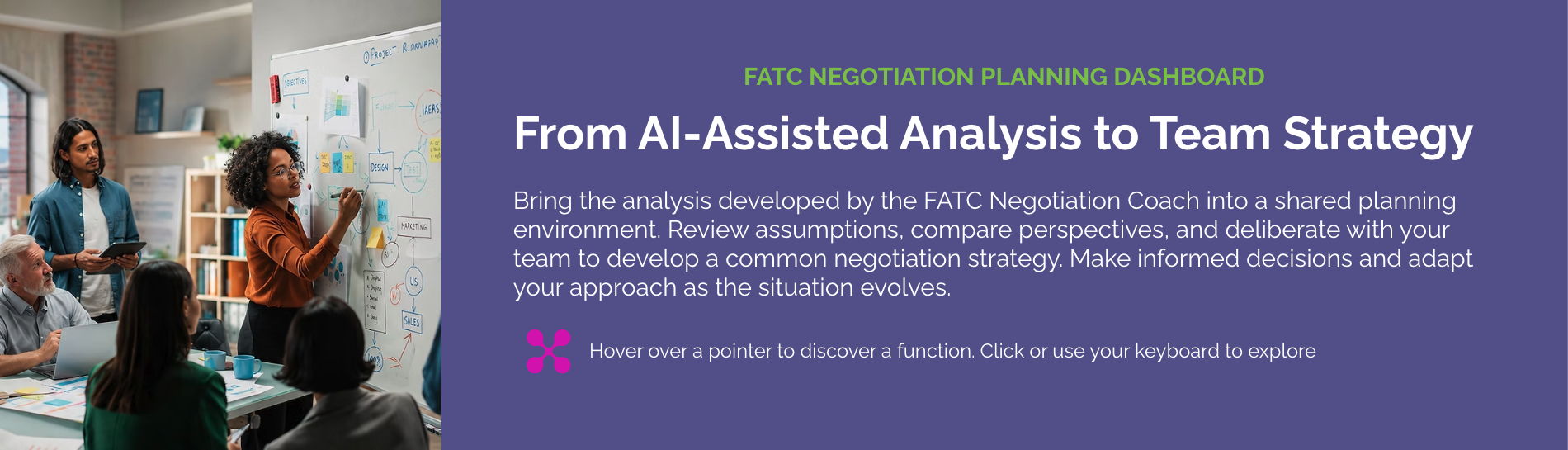
The dashboard brings together everything you have prepared. From here, you can keep your analysis up to date, share it with your team, prepare a briefing note and practise the meeting.

Consolidate your analysis

Bring together the planning templates and insight developed with the support of the FATC Negotiation Coach.

Review and monitor the situation and the parties

Revisit your analysis and bring new information at any point in time.

Develop and adapt your strategy

Update your analysis as the situation evolves and adjust your plans.

Share your analysis with your team

Challenge assumptions, compare perspectives, and explore strategic options through collective discussions.

Prepare a briefing note

Turn your analysis into a short note for your team or your management, ready to print.

Practise the meeting

Start a Negotiation Workout on the same case to test your preparation with the counterpart.

Practise the negotiation: the Negotiation Workout

Test your preparation in a meeting with the counterpart, played by your Coach from a confidential brief that you do not see. Then receive feedback on how you negotiated.

Difficulty of the negotiation
1
Foundation
2
Standard
3
Challenging
4
Advanced

Set up the meeting

Read your mandate and red lines. Choose what you want to train, from building trust to protecting the mandate and the integrity of the agreement, and set the difficulty of the negotiation from 1 to 4.

Meet the counterpart

Speak or type your turns. The counterpart answers in character and can be heard aloud. The meeting lasts up to 30 minutes and a set number of exchanges; you can pause or end it at any time.

Learn from the feedback

Your Coach rates the criteria you trained on four levels, quotes what worked, and suggests one thing to try next. Your dated, printable report shows your best level so far at the same difficulty, and suggests the next level when you are ready.

Your feedback is personal. Only anonymous figures, without your name or any of your words, are kept to improve the course.